

The Go Bag Test: How to Build a 72-Hour Kit You Can Actually Carry
Published May 19, 2026
View the current dashboard
HazardNow brings multiple public signals into one situational-awareness view. Open the live dashboard to review current indicators alongside the context in this article.
HazardNow provides context from public sources and is not a replacement for official alerts or emergency instructions.
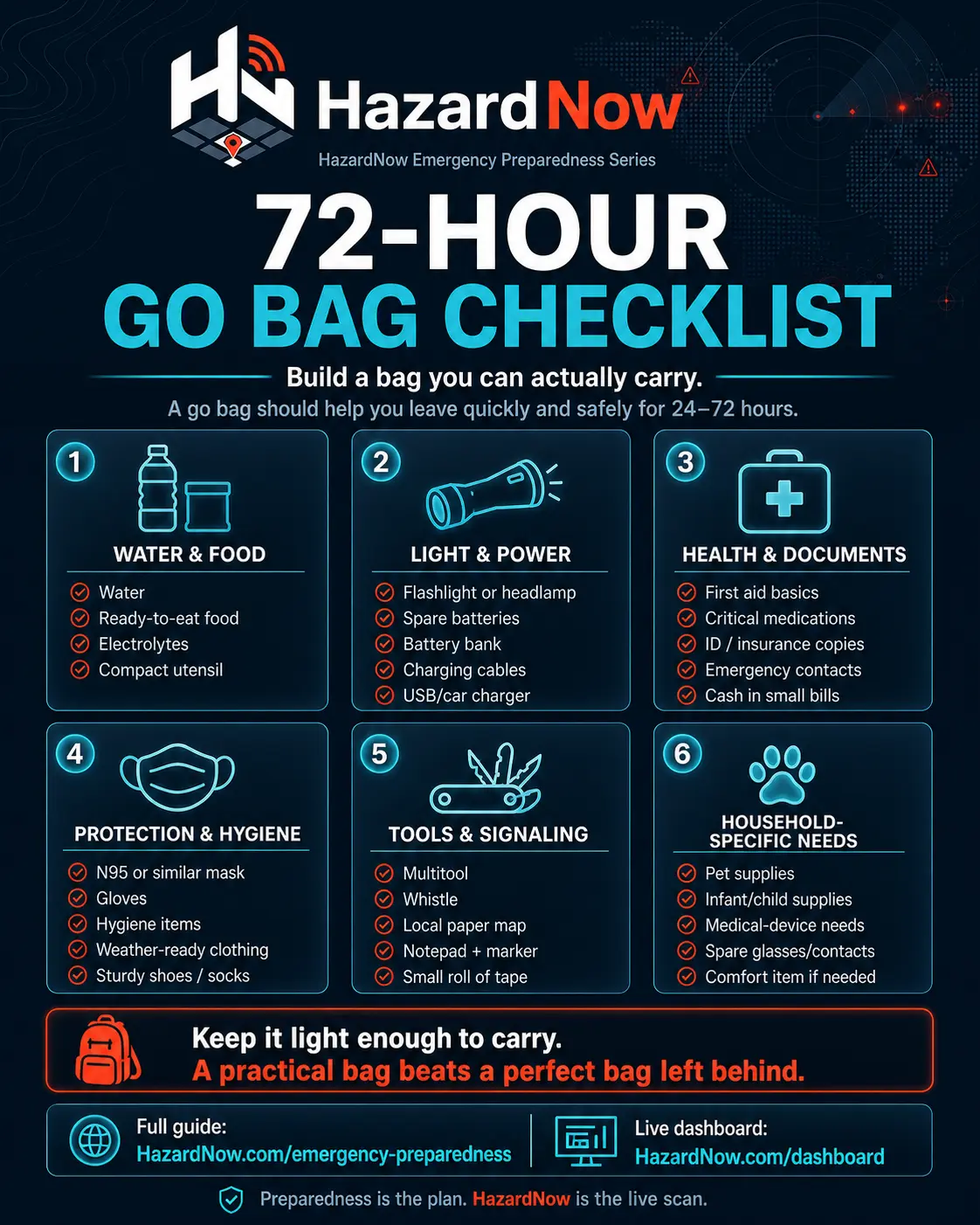
A go bag is most useful when it is practical, portable, and easy to maintain. The goal is not to carry everything you own. It is to cover essential needs for roughly 24 to 72 hours while you follow official guidance.
Build around the 24–72 hour planning window
Think in categories first, then quantity:
- Water and basic food
- Power and lighting
- Medications and personal medical items
- Copies of key documents
- Hygiene supplies
- First aid basics
- Household-specific needs (infants, pets, mobility aids)
Ready.gov guidance emphasizes water, food, communication, first aid, and core supplies for several days. Use that as a baseline and adjust for your household.
Run a test carry before you trust your setup
A packed bag is only helpful if you can use it under stress.
- Can you lift it safely?
- Can you walk with it for 10–20 minutes?
- Can you find items quickly without unpacking everything?
- Are medications, power banks, and batteries current?
If the answer is "not really," simplify and rebalance.
Before packing around a specific concern, review current public signals on the HazardNow live dashboard. Then use the full preparedness guide to refine your checklist.
This article is planning context, not emergency instruction. Follow official evacuation orders and public safety guidance from local authorities.
Related HazardNow guides
Use these supporting pages to connect this article with the live dashboard, source notes, and preparedness guidance.
Continue exploring HazardNow
Review current public signals on the live dashboard, compare them with historical county records, see what data categories HazardNow tracks, or build a practical preparedness routine before conditions change.
- See today’s live U.S. hazard conditions
- FEMA and NOAA disaster history by county
- What HazardNow tracks
- Emergency preparedness
- FAQ
- Data sources
For official alerts, warnings, evacuation notices, or emergency instructions, use authoritative sources and local agencies.